
Jazz Composition vs. Jazz Arrangement: Understanding the Key Differences

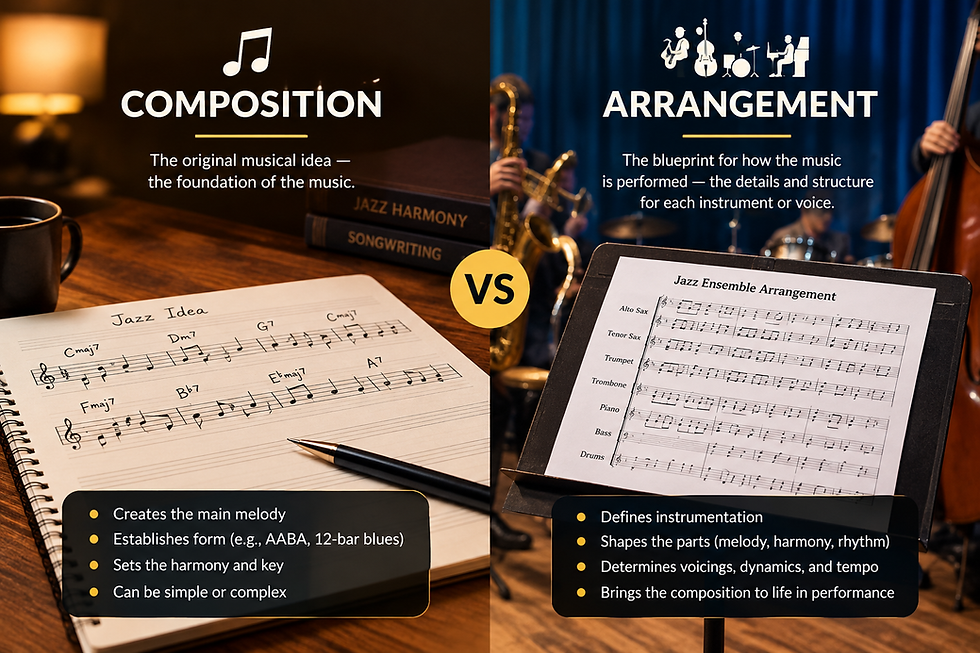
Many people use the terms composition and arrangement interchangeably, but in the world of jazz, they represent two distinct creative disciplines. While both require musical knowledge, creativity, and technical skill, composition and arrangement serve different purposes and involve different approaches to building a piece of music.
Understanding the distinction is important for composers, performers, educators, and anyone involved in the jazz community. Some musicians specialize primarily in composing original works, while others focus on arranging existing material for different ensembles and performance settings. Many professionals develop expertise in both areas, allowing them to expand their creative opportunities and serve a broader range of musical needs.
At Bridgewater Publishing Company, we regularly work with composers and arrangers who contribute to the jazz world in unique ways. This article explores the differences between jazz composition and jazz arrangement, examines the skills required for each discipline, and explains how both contribute to successful musical projects.
What Is Jazz Composition?
Composition is the process of creating original music from the ground up.
A composer develops the fundamental musical elements that form a piece, including:
Melody
Harmony
Form
Rhythm
Musical themes
Structural development
The composition serves as the foundation upon which performances, recordings, and arrangements are built.
When a jazz composer creates an original work, they are introducing new musical material that did not previously exist.
Examples of original compositional elements include:
A unique melody
An original chord progression
A newly developed form
Distinctive rhythmic concepts
Original thematic material
Composition represents the creation of the musical blueprint.
What Is Jazz Arrangement?
Arrangement involves adapting, organizing, or reimagining existing musical material.
An arranger takes a composition and determines how it will be presented by a specific ensemble or performer.
The arranger may make decisions regarding:
Instrumentation
Voicings
Harmonization
Soli sections
Background figures
Dynamics
Ensemble textures
An arrangement does not necessarily create new musical material. Instead, it shapes how existing material is performed and experienced.
For example, a jazz standard may be arranged for:
Small combo
Big band
Jazz orchestra
Vocal ensemble
Educational jazz group
Each arrangement can sound dramatically different while retaining the same underlying composition.
The Relationship Between Composition and Arrangement
Although composition and arrangement are different disciplines, they are closely connected.
A composer creates the core material.
An arranger develops how that material is presented.
Consider a simple melody.
The composer determines:
The notes
The harmony
The structure
The arranger decides:
Which instruments play the melody
How chords are voiced
When sections enter and exit
How soloists are featured
In many cases, composers also arrange their own music. However, understanding the separate responsibilities involved can improve both skills.
The Creative Process of a Composer
The compositional process often begins with an idea.
That idea may be:
A melodic fragment
A rhythmic pattern
A harmonic progression
An emotional concept
An improvisational idea
From there, the composer develops the material into a complete work.
The process may involve:
Sketching themes
Exploring harmonic possibilities
Establishing form
Refining transitions
Creating contrast and development
Composers focus primarily on creating original content.
Their goal is to produce music that communicates a distinct artistic vision.
The Creative Process of an Arranger
The arranger begins with existing material.
Their challenge is to determine how best to present that material for a specific performance situation.
An arranger might ask:
What instrumentation is available?
What is the skill level of the ensemble?
What style is desired?
How can the music be made more engaging?
The arranger then uses orchestration and organizational techniques to bring the composition to life.
Great arrangers often transform familiar music into entirely new listening experiences.
Skills Required for Jazz Composition
Successful jazz composers typically develop expertise in several areas.
These include:
Melody Writing
Creating memorable and expressive themes.
Harmony
Developing effective chord progressions and harmonic structures.
Form
Organizing musical ideas into coherent structures.
Rhythm
Designing grooves, phrasing, and rhythmic movement.
Musical Development
Expanding ideas throughout a composition.
Strong compositional skills provide the foundation for all other aspects of jazz writing.
Skills Required for Jazz Arrangement
Arranging requires a somewhat different skill set.
Important arranging skills include:
Orchestration
Understanding how instruments function individually and collectively.
Voicing
Distributing chord tones effectively throughout the ensemble.
Instrumentation
Knowing the strengths and limitations of different instruments.
Dynamics and Balance
Managing texture and volume throughout the arrangement.
Ensemble Writing
Creating effective interactions between sections.
An arranger's expertise often determines how successful a composition sounds in performance.
Why Arrangement Matters in Jazz
Some musicians underestimate the importance of arranging.
However, many legendary jazz recordings owe much of their impact to exceptional arrangements.
Strong arrangements can:
Highlight soloists
Improve ensemble balance
Increase audience engagement
Create dramatic contrast
Showcase harmonic sophistication
The same composition can produce vastly different results depending on the quality of the arrangement.
Arrangement often serves as the bridge between composition and performance.
Small Combo Arranging vs. Big Band Arranging
The role of the arranger changes depending on ensemble size.
Small Combo Arranging
Typically emphasizes:
Flexibility
Improvisation
Open forms
Minimal notation
Big Band Arranging
Requires:
Detailed orchestration
Written voicings
Sectional balance
Precise coordination
As ensemble size increases, arranging responsibilities generally become more extensive.
Understanding these differences helps composers and arrangers tailor their work appropriately.
Can an Arrangement Become a New Creative Work?
In some cases, yes.
A highly creative arrangement may introduce substantial new material, including:
Reharmonization
New introductions
Soli passages
Countermelodies
Structural modifications
While the original composition remains intact, the arrangement itself may represent a significant artistic contribution.
This is especially common in jazz, where reinterpretation plays a major role in artistic expression.
Educational Benefits of Studying Both Disciplines
Composers benefit from studying arranging.
Arrangers benefit from studying composition.
Understanding both disciplines helps musicians:
Improve orchestration
Strengthen harmonic understanding
Write more effectively for ensembles
Communicate ideas clearly
Expand professional opportunities
Many successful jazz professionals develop skills in both areas throughout their careers.
Common Misunderstandings
Several misconceptions often create confusion.
Misconception 1: Composition Is More Important Than Arrangement
Both disciplines are essential.
A great composition can suffer from poor arrangement, while a great arrangement can elevate a composition significantly.
Misconception 2: Arranging Is Easier
Arranging requires extensive technical knowledge and creative decision-making.
Misconception 3: Only Composers Create
Arrangers make countless creative choices that influence the final result.
Misconception 4: Small Ensembles Do Not Need Arrangements
Even small groups benefit from thoughtful organizational planning and musical direction.
Understanding these realities helps musicians appreciate both disciplines more fully.
Career Opportunities for Composers and Arrangers
Both fields offer a variety of professional opportunities.
Potential paths include:
Music publishing
Educational music
Commissioned works
Film and media scoring
Performance ensembles
Studio projects
Licensing opportunities
Developing skills in both composition and arrangement can significantly expand career possibilities.
How Bridgewater Publishing Company Supports Composers and Arrangers
Bridgewater Publishing Company works with composers and arrangers across a wide range of jazz projects.
Our services include:
Original composition support
Arrangement review
Professional score preparation
Publishing assistance
Copyright guidance
Catalog development
Educational music services
We help creative professionals bring their musical ideas to life while preparing their work for publication and performance.
FAQs
What is the main difference between composition and arrangement?
Composition creates original musical material, while arrangement determines how that material is presented and performed.
Can the same person be both a composer and an arranger?
Yes. Many jazz professionals develop expertise in both disciplines.
Which is more important in jazz?
Both are important. Composition provides the foundation, while arrangement shapes the performance experience.
Do small jazz groups need arrangements?
Yes. Even minimal arranging can improve organization, balance, and musical effectiveness.
Does Bridgewater Publishing support both composers and arrangers?
Yes. We provide services for original compositions, arrangements, publishing, and professional music preparation.
Next Steps
Understanding the distinction between composition and arrangement helps musicians develop stronger creative skills and make more informed artistic decisions. While composition focuses on creating original musical ideas, arrangement determines how those ideas are brought to life in performance. Together, these disciplines form the foundation of successful jazz writing.
Bridgewater Publishing Company is proud to support composers and arrangers as they develop their craft, expand their catalogs, and contribute to the continuing evolution of jazz music.


Comments