
Understanding Jazz Harmony: A Guide for Emerging Composers

Updated: Jul 9

Harmony is one of the defining elements that separates jazz from many other musical genres. While improvisation often receives the most attention, it is harmony that provides jazz with its rich emotional depth, sophisticated character, and endless possibilities for creative expression. Whether listening to a classic swing arrangement, a bebop standard, a modal jazz composition, or a modern fusion recording, harmony plays a central role in shaping the listener's experience.
For emerging composers, learning jazz harmony is one of the most important steps toward developing a unique musical voice. A strong understanding of harmonic concepts allows composers to create more engaging melodies, write stronger arrangements, support improvisation effectively, and communicate emotion with greater precision. It also provides the foundation needed to experiment creatively while maintaining musical coherence.
At Bridgewater Publishing Company, we have spent decades working with composers who want to improve their writing and expand their musical vocabulary. Understanding jazz harmony is often one of the most valuable investments a developing composer can make. This guide explores the fundamental principles of jazz harmony, explains how they evolved, and demonstrates how composers can apply them in their own work.
Why Harmony Matters in Jazz
Harmony serves several important functions within a composition. It creates mood, supports melodies, establishes tension and release, and helps guide the listener through a musical journey.
In jazz, harmony often takes on an even greater role because of the genre's emphasis on improvisation. Soloists rely on harmonic frameworks to shape their ideas, and arrangers use harmonic color to create texture and variety throughout a piece.
Strong harmonic writing can:
Create emotional depth
Support memorable melodies
Enhance improvisation
Improve ensemble interaction
Add sophistication to arrangements
Establish a unique compositional voice
Without a strong harmonic foundation, even technically impressive compositions can feel incomplete or directionless.
The Building Blocks of Jazz Harmony
Every composer should begin by mastering the basic harmonic structures that serve as the foundation of jazz writing.
Seventh Chords
Unlike many popular music styles that rely heavily on triads, jazz harmony is built around seventh chords.
Common seventh chords include:
Major seventh chords
Minor seventh chords
Dominant seventh chords
Half-diminished seventh chords
Fully diminished seventh chords
Each chord type serves a specific purpose and creates a distinct emotional effect.
For example, major seventh chords often sound warm and sophisticated, while dominant seventh chords create tension that naturally seeks resolution.
Learning how these chords function within progressions is essential for any jazz composer.
Functional Harmony
Functional harmony refers to the relationships between chords and how they create movement within a composition.
The three primary harmonic functions are:
Tonic
Subdominant
Dominant
Understanding these functions allows composers to create progressions that feel logical and satisfying while still leaving room for creative variation.
The Importance of the II-V-I Progression
Few harmonic movements are more important in jazz than the II-V-I progression.
In the key of C major, the progression is:
Dm7 – G7 – Cmaj7
This progression appears in countless jazz standards and serves as one of the most important frameworks for both improvisation and composition.
The II-V-I progression teaches composers how tension and resolution operate within jazz harmony.
As composers develop, they often learn to modify and expand these progressions using substitutions, extensions, and reharmonization techniques.
Mastering II-V-I progressions in every key is one of the most valuable exercises a jazz composer can undertake.
Understanding Chord Extensions
One of the characteristics that gives jazz its distinctive sound is the use of chord extensions.
Rather than stopping at the seventh, jazz composers frequently add:
Ninths
Elevenths
Thirteenths
These extensions create additional color and complexity without fundamentally altering the chord's function.
For example:
A Cmaj7 chord may become:
Cmaj9
Cmaj11
Cmaj13
Each version provides a slightly different emotional quality and texture.
Extensions allow composers to create richer harmonic landscapes while maintaining clarity within the progression.
Altered Dominants and Harmonic Tension
Jazz composers often manipulate dominant chords to create stronger tension before resolution.
Common alterations include:
Flat ninths
Sharp ninths
Sharp elevenths
Flat thirteenths
These altered tones increase harmonic intensity and create a stronger desire for resolution.
When used carefully, altered dominant chords can dramatically enhance emotional impact within a composition.
Many bebop and post-bop composers rely heavily on altered harmony to create excitement and forward momentum.
Modal Harmony and Modern Jazz
The development of modal jazz expanded the possibilities of jazz composition significantly.
Rather than emphasizing constant chord changes, modal harmony focuses on scales or modes as the primary organizational structure.
Common jazz modes include:
Dorian
Mixolydian
Lydian
Aeolian
Phrygian
Modal writing provides composers with:
Greater melodic freedom
Open harmonic space
Extended improvisational opportunities
Strong atmospheric qualities
Many contemporary jazz composers continue to explore modal concepts in both small ensemble and large ensemble settings.
Reharmonization Techniques
Reharmonization is the process of changing the underlying chords beneath an existing melody.
This technique allows composers to create fresh interpretations of familiar material and develop unique harmonic identities.
Common reharmonization approaches include:
Secondary Dominants
Secondary dominants temporarily emphasize chords other than the primary tonic.
These chords create additional movement and tension within a progression.
Tritone Substitutions
Tritone substitutions replace one dominant chord with another dominant chord located a tritone away.
For example:
G7 may be replaced by Db7.
This creates smooth chromatic movement and adds sophistication to harmonic progressions.
Modal Interchange
Modal interchange involves borrowing chords from parallel modes.
This technique allows composers to introduce unexpected colors while maintaining a strong connection to the original key center.
Voice Leading: The Secret Behind Smooth Harmony
One of the most overlooked aspects of jazz harmony is voice leading.
Voice leading refers to how individual notes move from one chord to the next.
Excellent voice leading creates:
Smooth transitions
Strong melodic connections
Cohesive harmonic movement
Improved ensemble balance
Many developing composers focus exclusively on chord symbols and overlook the importance of internal note movement.
Professional composers understand that even complex harmonies can sound natural when voice leading is handled effectively.
Applying Harmony to Jazz Arranging
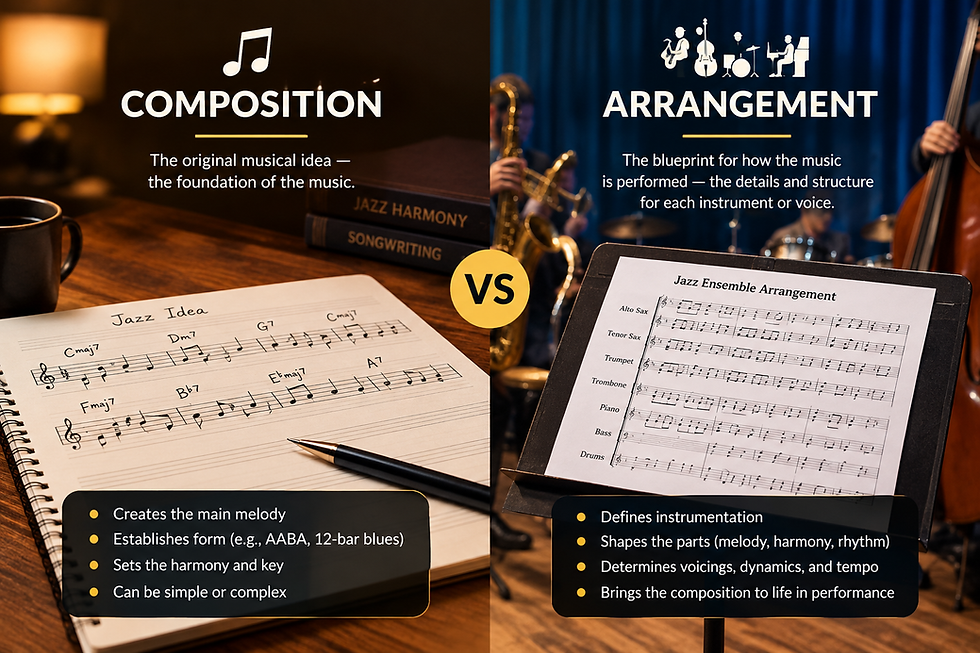
Harmony and arranging are inseparable.
An arranger must determine:
Which instruments carry specific chord tones
How sections interact harmonically
How to distribute tension and release
When to use dense or transparent textures
In a big band setting, harmonic choices directly affect:
Ensemble balance
Color
Energy
Emotional impact
Strong harmonic understanding leads to stronger arrangements and more effective performances.
Common Harmonic Mistakes New Composers Make
Many emerging composers encounter similar challenges while developing their harmonic skills.
Overcomplicating Chord Progressions
Complexity does not automatically create quality. Effective harmonic writing prioritizes clarity and musical purpose.
Ignoring Melody
Harmony should support and enhance the melody rather than compete with it.
Weak Voice Leading
Interesting chords can lose their impact when transitions between them feel awkward.
Overusing Extensions
Extensions are powerful tools, but excessive use can create cluttered textures.
Avoiding Simplicity
Some of the most memorable jazz compositions rely on relatively simple harmonic structures executed exceptionally well.
Developing Your Harmonic Vocabulary
Improving harmonic skills requires ongoing study and active listening.
Effective ways to develop include:
Studying jazz standards
Transcribing recordings
Analyzing scores
Practicing chord progressions in every key
Experimenting with reharmonization
Writing regularly
Harmony is a lifelong area of study, and even experienced composers continue refining their understanding throughout their careers.
How Bridgewater Publishing Company Supports Composers
Bridgewater Publishing Company works closely with emerging and experienced composers seeking to strengthen their compositional skills.
Our services include:
Composition support
Arrangement review
Professional score preparation
Publishing guidance
Catalog development
Educational resources
Copyright assistance
We help composers transform creative ideas into polished works ready for performance, publication, and long-term career development.
FAQs
What is the most important progression in jazz?
The II-V-I progression is considered the foundation of jazz harmony and appears in countless compositions.
Do I need advanced theory to begin writing jazz?
No. Strong fundamentals provide a solid foundation. Advanced concepts can be added gradually as your understanding grows.
What are chord extensions?
Chord extensions are notes added beyond the seventh, such as ninths, elevenths, and thirteenths, that create additional harmonic color.
Why is voice leading important?
Voice leading creates smooth movement between chords and helps maintain musical coherence.
Does Bridgewater Publishing help composers improve their harmonic writing?
Yes. We provide guidance, feedback, and professional support to help composers strengthen all aspects of their craft.
Next Steps
Understanding jazz harmony is one of the most important steps toward becoming a stronger composer. By mastering fundamental concepts, exploring advanced techniques, and applying harmonic principles intentionally, composers can create music that is expressive, sophisticated, and uniquely their own.
Bridgewater Publishing Company is committed to helping composers grow their skills, refine their catalogs, and build successful careers in jazz composition and publishing.


Comments